
Comprehensive Failure Tracking Features
Failure Tracking & Analytics
Comprehensive failure dashboard with occurrence trends, resolution metrics, and heat maps to visualize when failures happen most frequently.
Knowledge Base & Solutions
Document, vote, and discuss solutions to common failures with team collaboration. Build an organizational knowledge base for faster resolution.
Advanced Filtering
Regex search, bulk actions, and smart filters to quickly identify critical failures. Filter by repository, workflow, status, and occurrence frequency.
Resolution Insights
Track MTTR (Mean Time To Resolution), resolution rates, and top failing workflows to improve team efficiency and reduce downtime.
See It In Action
Get a glimpse of our powerful failure analysis dashboard with comprehensive tracking and analytics.
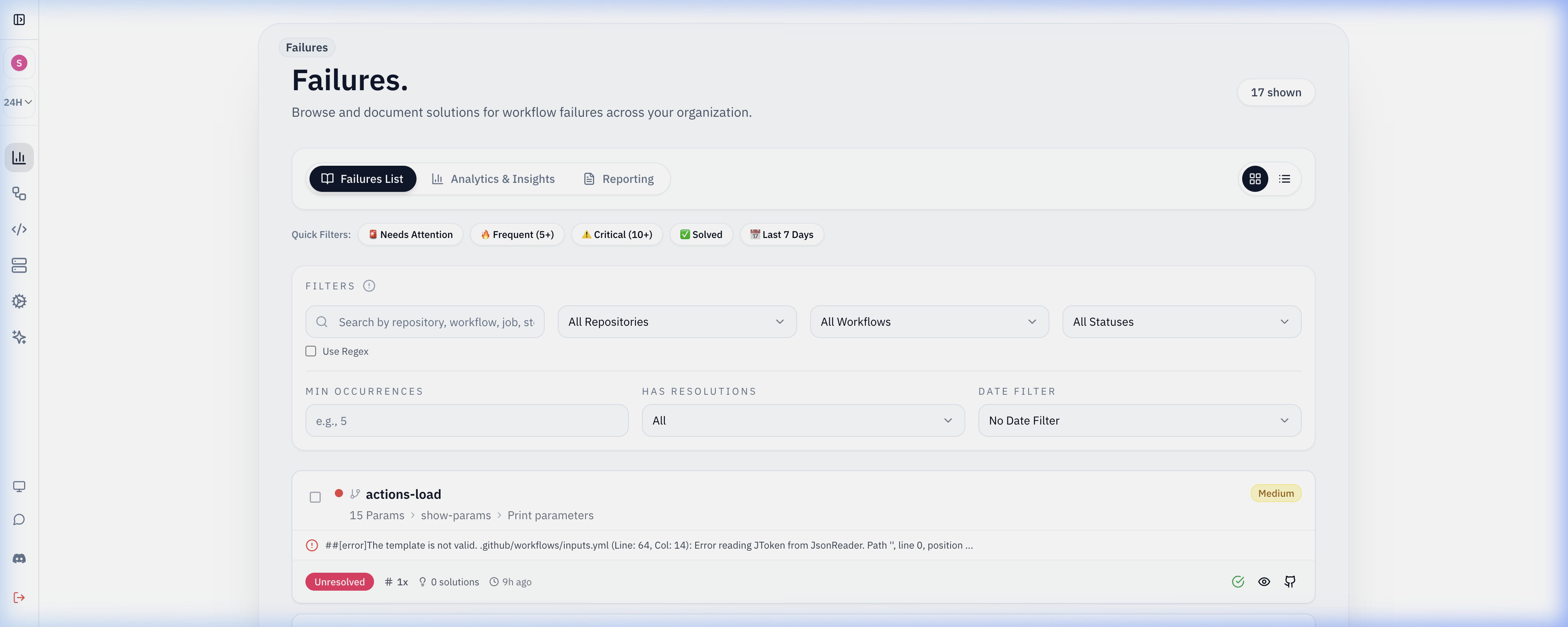
Our intuitive dashboard gives you complete visibility into workflow failures, helping you identify patterns and resolve issues faster than ever.
How Failure Analysis Works
A comprehensive system for tracking, analyzing, and resolving workflow failures across all repositories.
Automatic Failure Detection
All workflow failures are automatically detected and tracked with full error logs, context, and metadata. No configuration required.
Smart Categorization & Analytics
Failures are grouped by similarity, analyzed for patterns, and visualized with charts and heat maps. Quickly identify critical issues needing attention.
Collaborate & Document Solutions
Team members can document solutions, vote on fixes, add comments, and link pull requests. Build a knowledge base that reduces MTTR over time.
Track & Measure Improvement
Monitor resolution rates, MTTR, and other key metrics to measure team performance and identify areas for improvement.
Key Benefits
Transform how your team handles workflow failures
Reduce MTTR
Cut mean time to resolution by leveraging documented solutions and team knowledge
Team Collaboration
Enable your team to share solutions, vote on fixes, and build collective knowledge
Continuous Improvement
Track metrics over time to measure improvements and identify recurring issues
Structured failure resolution
Gitera groups recurring failures by workflow, error signature, and repository so teams stop fixing the same flaky test in isolation.
A shared knowledge base lets engineers document solutions, vote on fixes, and reduce repeat incidents. Failures that are known to be transient can be absorbed by auto-retry rules instead of paging someone.
MTTR and resolution-rate metrics show whether reliability initiatives are actually working over time.
Failure Analysis FAQ
How do I find the root cause of a failed GitHub Actions workflow?
Start from the failing job and step, then check whether the same error appeared in other runs. Gitera records every failed run with its workflow, job, branch, and error, links similar past failures, and shows the resolutions teammates documented for them, so you are not reading raw logs from scratch each time a familiar error returns. Errors known to be transient can be handled by auto-retry instead.
What is a good MTTR for CI/CD failures?
There is no universal target, but the trend matters more than the number: mean time to resolution should fall as recurring failures get documented. Gitera measures MTTR and resolution rates from when a failure is detected until it is marked resolved, so you can see whether reliability work is shortening recovery time month over month, alongside success-rate trends on the GitHub Actions dashboard.
How does Gitera detect recurring GitHub Actions failures?
When a run fails, Gitera compares it with earlier failures from the same organization and surfaces up to five similar ones. Engineers see the workflow, job, and error that matched, plus any resolution already written for those failures, which turns one engineer's fix for a flaky dependency or runner error into shared team knowledge.
Can my team share fixes for CI failures?
Yes. Every failure can carry written resolutions that teammates add and vote on, so the most useful fix rises to the top. The next time the same error appears in any repository, the documented resolution is shown alongside it, which reduces repeated investigation and makes on-call handovers far less dependent on individual memory.
Related Gitera capabilities
Guides on the Gitera blog
Explore all features on the Gitera homepage or read insights on the blog.